
Checking for a Warrant in Williamson County
Williamson County publishes no single public warrant roster. That is the first thing to know. The Sheriff's FAQ does offer a controlled path for county-held warrants: come to the Sheriff's Office with photo identification, or have your attorney fax a request on official letterhead. Phone and email questions get no confirmation. The Warrant Division takes no payments either. A city citation belongs to that municipal court, while a traffic ticket from a Justice of the Peace goes to the precinct printed on the ticket. Bring the full name plus any citation, cause, or court number, since a common name alone may pull the wrong file. Where arrest is a real risk, have an attorney call the issuing court before you choose a payment, appearance, or surrender route.
- Read the citation or court notice and identify the issuing court, city, and case number.
- Use the county Court Case Lookup for criminal case context, knowing it is not a countywide warrant list.
- Ask a municipal or JP court about its own citation, missed-date, or capias record.
- For Sheriff-held confirmation, visit with photo ID or ask counsel about the official-letterhead fax route. A written public-records request is a separate option.
- Ask the issuing court or an attorney about recall, payment, bond, or a new setting, then keep written confirmation.
Williamson County Uses Several Record Systems
One Court Case Lookup page is where the county gathers its tools. It links a criminal-record search and a jail lookup. Each answers a different question, one for finding a case and one for custody status. Neither is presented as a complete active-warrant roster. A name missing from a screen does not settle whether a city, JP, or sealed record exists. Williamson County's four Justice Court precincts handle traffic and other lower-level matters. Municipal courts keep their own city citations. The Sheriff's public-records process can route a records request, but getting a record and confirming a warrant are two different questions, so the court or agency holding the file is the real destination.
Williamson County Warrant Types
Who issues a warrant in Williamson County depends on the case and the court's role. A magistrate can issue an arrest warrant on a complaint and probable-cause process. Miss a court obligation and a bench warrant or capias may follow. An unpaid judgment in a Class C matter can bring a capias pro fine. Search warrants authorize a search under court process. They are not the same as a public name-search result.
| Warrant Type | How It Arises | Who Issues It |
|---|---|---|
| Arrest warrant | Complaint and probable-cause review | Authorized Texas magistrate |
| Bench warrant | Missed setting or failed court order | Issuing judge or court |
| Search warrant | Request for authority to search | Magistrate under Texas law |
| Capias / capias pro fine | Failure to appear or satisfy a Class C judgment | Issuing JP or municipal court |
City and Precinct Warrants Stay Local
A warrant tied to a city citation may sit with that city's police department or municipal court, even if the person lives elsewhere in Williamson County. A county road ticket can belong to a JP precinct instead. The Sheriff warns plainly that city-held warrants may not appear in its files. Geography alone will not identify the court. The citation, the cause number, and the issuing agency matter most. On a municipal case, the city court controls payment, appearance, and recall. On a JP traffic matter, the named precinct does. A county jail lookup or a nearby police counter is no substitute for the issuing court's current status.
Inside a Williamson County Warrant Record
A record can list a cause or citation number, the court, the alleged offense, a bond or fine amount, and case events. Williamson County's public bail-form search runs on name, cause number, magistration location, offense, and action. That form helps with bail context. It does not prove every active warrant is indexed.
| Case reference | Cause or citation number identifies the court file; formats differ by court. |
|---|---|
| Name | Use the person named in the official case or warrant record. |
| Offense | Read the listed charge or violation with the court record. |
| Issuing court | Shows which court controls the case and any recall request. |
| Bond or fine | Check the amount and accepted method with the issuing office. |
| Action or status | A bail event, service entry, or court action may not show the current warrant status. |
The Texas public bail-form search offers a schema example. Treat its fields as case context, then confirm any warrant with the issuing court or the Williamson County Sheriff.
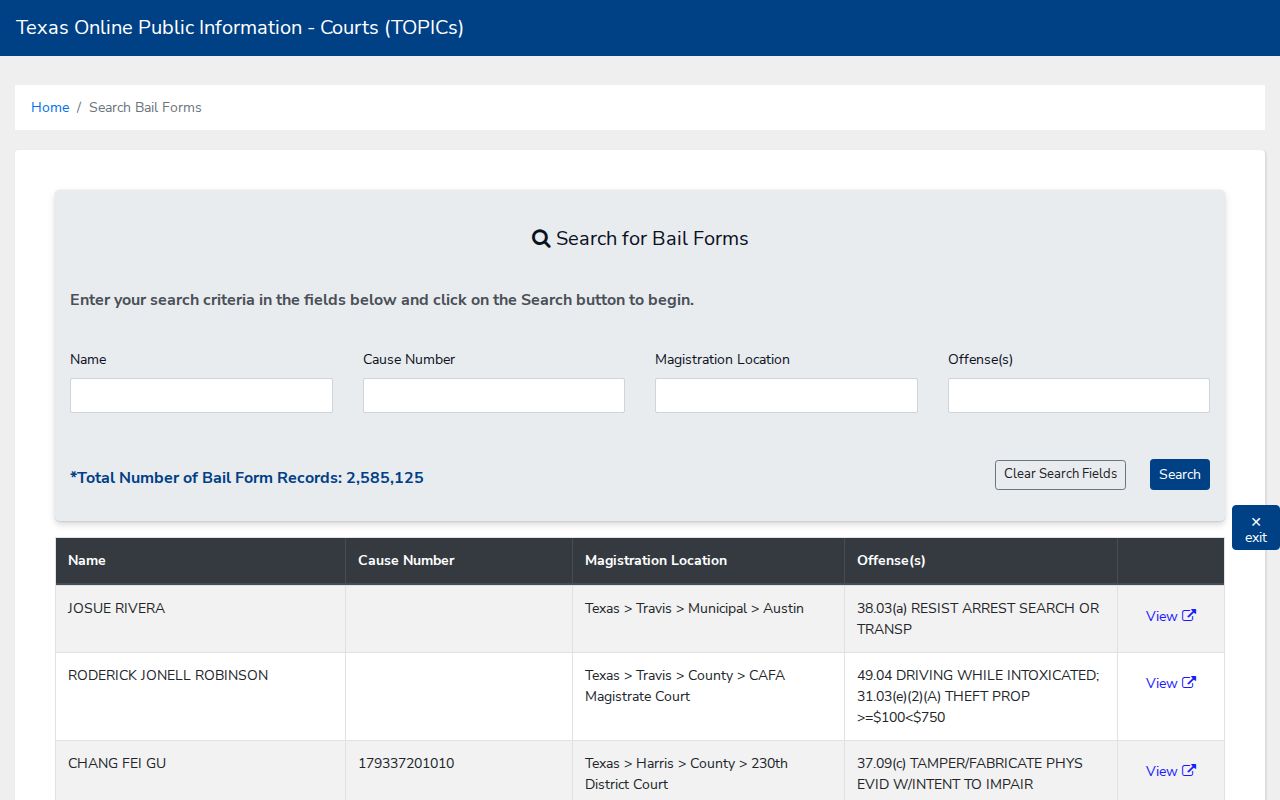
This blank official form shows what a bail search can ask for. It is not a complete Williamson County warrant roster.
Williamson County Search Screens Have Limits
The county links an official Williamson County criminal-record search, though the county does not document its search fields. Use it for case context, not as proof that a result is an active warrant. The jail lookup is a separate custody tool, and an arrest or booking record does not answer every court question. Lead with the case number when you have one. If the search comes back silent, ask the clerk which court is assigned and follow that court's process. This is a local access gap, not a reason to lean on commercial people-search results.
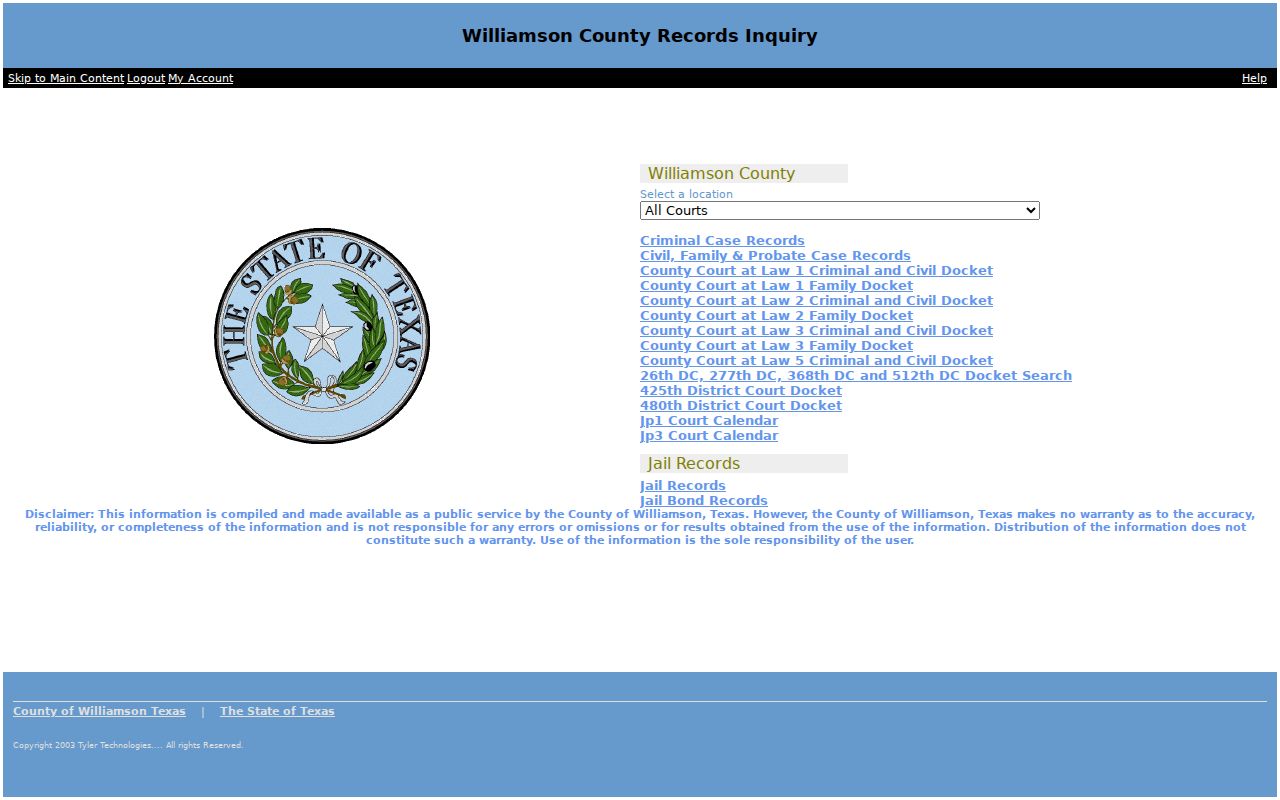
The county's landing page keeps criminal records, jail lookup, and other case categories separate. Pick the Williamson County screen that matches your question.
Issuing and Serving Warrants in Williamson County
Courts and magistrates authorize warrants in Williamson County. The Sheriff, constables, and city police may serve them. Criminal district assignments include the 26th, 277th, and 368th District Courts. County Courts at Law handle their assigned matters. JP and municipal courts do much of the local traffic and Class C work. The officer who serves a warrant is not the court that can recall it.
Williamson County Sheriff's Office
508 S. Rock Street
Georgetown, TX 78626
512-943-1300, general contact
Williamson County Clerk Routes Depend on the Court
Williamson County splits its clerk duties by court, so knowing your court comes first. The District Clerk holds the district-court pleadings and papers, which covers felony criminal files. The County Clerk's Courts Division handles county-court-at-law records instead. Justice Courts and municipal courts keep their own citation and Class C workflows. The county's District Clerk page and County Clerk page lay out these separate routes. Neither clerk runs a universal warrant desk. Before filing a records request, ask which court is assigned. A copy of a file, a question about an active warrant, and a motion to recall are three different actions, and each goes to a different office in Williamson County.
Williamson County Has No Countywide Amnesty
No countywide amnesty or warrant-roundup event covers Williamson County. The options are court-specific. Round Round describes an Initial Appearance for its own municipal warrants, and other cities publish their own payment, appearance, and plan routes. Those programs do not touch a JP, district, or neighboring city case. Williamson County Crime Stoppers takes anonymous tips on public-safety matters, but that program is separate from checking or resolving your own case. For status, use the issuing court. For advice about a safe appearance, use counsel.
If You Have a Warrant in Williamson County
Start by identifying the issuing court and the type of process. Ask a lawyer about a motion to recall or quash, a voluntary appearance, or a bond route before you walk up to a counter or jail. The Sheriff confirms county-held warrants in Williamson County only through its stated in-person photo-ID or attorney-fax process. It takes no warrant payments. Payment or recall belongs with the issuing authority.
Important: A payment receipt, jail release, or DPS update is not the court order; ask the issuing court for written confirmation and the next required setting.
Williamson County Bond and Release Records Are Separate
The Williamson County Magistrates Office runs bail hearings all year, but magistration does not end the case or recall a warrant by itself. The county's personal-recognizance information lays out PR, cash, and surety bond options, plus a 3% administrative fee on the PR bond. The assigned court still controls the underlying case and the conditions that follow release. Keep your bond paperwork, release order, court setting, and warrant-status confirmation together. Each answers a different question.
Williamson County Warrant Records and Public Access
The Texas Public Information Act governs many government records, yet it does not make every warrant file public. An agency can withhold material tied to an open investigation. Juvenile records face separate limits. Court records also follow the rules for their court and case type. When you request a public or redacted copy in Williamson County, describe the event, court, date, and case number if you know them.
Key Rules:
Texas Government Code Chapter 552 sets the public-information process and law-enforcement exceptions.
Texas Family Code Chapter 58 restricts access to juvenile records, including specified warrant material.
Texas Code of Criminal Procedure Chapter 15 governs arrest warrants and magistrate authority.
Texas Code of Criminal Procedure Chapter 45A covers justice and municipal-court procedure, including capias pro fine process.
Williamson County DPS Holds Are a Separate Check
Texas has no single public statewide warrant search. DPS works with OmniBase on reported failure-to-appear and failure-to-pay matters that may block license renewal. The program leaves out some violations. DPS license staff cannot confirm whether a warrant exists. The DPS program page points people to the court that reported the case. Treat this state layer as one clue, then contact the issuing JP or municipal court in Williamson County. The local court's status still governs payment, recall, and case settings.
Williamson County Warrants by City
City courts handle their own traffic, ordinance, and missed-date cases. The 2020 Census ranking below identifies the five city profiles covered here, not a ranking of courts or warrant volume. Start with the city named on the citation. Then ask the Williamson County court holding any separate case.
Round Rock Warrant Records
119,468 residents in 2020 · Initial Appearance for city-court warrants.
Cedar Park Warrant Records
77,595 residents in 2020 · city active list updated weekdays.
Georgetown Warrant Records
67,176 residents in 2020 · city portal and warrant-unit procedures.
Leander Warrant Records
59,202 residents in 2020 · full-time police warrant officer.
Hutto Warrant Records
27,577 residents in 2020 · two court-of-record divisions.